

Picture this: it’s Friday evening, you’re pouring a drink and you open up your favourite online casino for a spin. But instead of the familiar game lobby, you’re met with a daunting ‘Access Denied’ screen or a notification that the site has been blocked under federal legislation. That feeling of disappointment is familiar to thousands of Australian punters who face the reality of internet regulation.
As a long-time PokieKing.com analyst, I’ve been watching this game of cat and mouse between regulators and operators closely. Despite active blocking by ACMA (the Australian Communications and Media Authority), the demand for quality high-RTP pokies and generous bonuses isn’t just holding steady – it’s growing. Punters continue to seek pathways to freedom of choice, and the market is responding with technological solutions.
In this article, we’ll pull apart the reasons behind these blocks, how the restriction mechanisms work, and most importantly, why offshore sites (like those licensed in Curaçao) remain the primary choice for Aussies and Kiwis in 2026. We’ll talk about safety, banking nuances, and how to stay in the game without breaking the law.
What is the ACMA Blacklist and How Does it Work?

To grasp the heart of the issue, you need to look ‘under the bonnet’ of Australian legislation. ACMA operates under the authority of the Interactive Gambling Act 2001 (IGA). This law prohibits the provision of certain interactive gambling services (like online casinos and ‘in-play’ sports betting) to people located in Australia. It’s crucial to understand: the law targets operators, not punters. However, the tool of this fight is often technical access blocking.
The regulator regularly updates its list of prohibited sites and directs internet service providers (ISPs) to restrict access to them. But how does this actually work technically, and why does it specifically affect your favourite pokies sites?
The Mechanics of ISP Blocking
In most cases, blocking happens at the DNS (Domain Name System) level. When you type a casino’s address into your browser, your computer queries your provider’s DNS server (like Telstra’s or Optus’s) to find the site’s IP address. If the site is on ACMA’s online casinos blacklist, the provider returns the address of a ‘block page’ – a warning notice – instead of the real address.
This is a fairly primitive method, akin to removing a street sign and hoping no one finds the house. Experienced users know that changing DNS servers or using a VPN easily bypasses this hurdle, restoring access to the best online casinos in a matter of seconds.
Why Offshore Sites Become Targets
Australia has a strict licensing system that, unfortunately for many punters, does not provide for licences for online pokies or table games (blackjack, roulette). Licences are only issued for sports betting and lotteries. This creates a vacuum: the demand for casino games is huge, but there’s no legal local supply.
As a result, all international sites offering these services to Australians are technically considered ‘unlicensed’ in ACMA’s eyes, even if they hold a reputable Curaçao or Malta licence. This is precisely why the blacklist includes the best offshore casinos, which are considered legal and reliable elsewhere in the world.
Why Punters Choose Offshore Casinos Over Local Options

If the government is trying so hard to shield players from offshore sites, why isn’t the flow of those wanting to play there drying up? The answer lies in the quality of the product. The local Australian gambling market is heavily restricted: you can bet on cricket or the horses, but you can’t spin a progressive jackpot slot from your lounge room.
For the modern player accustomed to digital comfort, offshore platforms are the only way to get a full casino experience. The gap between what’s permitted locally and what’s available globally has become simply colossal by 2026.
Analyst’s View: Analysing the IGA 2001 for years, I see that the law simply can’t keep pace with technology. By blocking sites to ‘protect’ consumers, ACMA often just pushes players towards using mirrors of the same brands. The key isn’t in bans, but in knowing how to choose brands that pay out consistently, despite regulatory storms.
Immense Game Variety & Progressive Pokies
The main argument ‘for’ is the providers. On offshore sites you’ll find thousands of games from industry giants like Pragmatic Play, NetEnt, or Evolution Gaming. These are games with excellent graphics, complex mechanics, and RTP (return to player) often exceeding 96-97%.
Local Australian alternatives (brick-and-mortar pubs) often offer pokies with a much lower RTP, making online play mathematically more favourable. Furthermore, access to global progressive jackpots is only possible on international platforms.
Competitive Bonuses & Loyalty Programs
Australia has strict restrictions on advertising bonuses for sports betting. Offshore casinos aren’t bound by these rules. This allows them to offer aggressive welcome packages. Our bonus audits show the average welcome bonus in 2026 can reach into the thousands of dollars plus hundreds of free spins.
No deposit bonuses are also popular, giving you a chance to test a casino without risking your own funds. For the locally regulated market, such offers are taboo.
The Rise of Crypto & Privacy
Another major factor is anonymity. Crypto casinos allow you to play without handing your personal banking details over to third parties. Transactions in Bitcoin, USDT, or Ethereum are instant and can’t be blocked by Australian banks, solving one of the main headaches for local players.
| Feature | Local (Sport/Lottery) | Offshore (Pokies) |
|---|---|---|
| Online Pokies | No | Yes (thousands of slots) |
| Crypto Support | No | Yes (BTC, ETH, USDT) |
| Welcome Bonuses | Heavily restricted | Aggressive & generous |
| Tax on Winnings | No | No |
As the table shows, offshore platforms win on functionality, despite the legal complexities. It’s precisely this imbalance that drives punters to find ways around the blocks.
Technical Workarounds: How Players Stay Connected

For many newcomers, seeing a favourite site hit the blacklist seems like game over. However, experienced players know an ACMA block is, in essence, a ‘speed bump’, not a concrete wall. There are several tried-and-true methods that can restore access to your account and balance in a matter of minutes.
Casino operators are well aware of the Australian market’s specifics and prepare technical solutions in advance to ensure uninterrupted play. Let’s look at the most popular methods relevant in 2026.
Personal Example: Recently, I was testing a popular offshore casino that got hit with an ISP block mid-week. Literally within four hours, the operator sent an email with a link to a fresh mirror. I logged in, and my balance along with the active bonus were right there – no data loss or stress.
Mirror Sites & Alternative Domains
A mirror is an exact copy of a casino’s main site, hosted on a different domain name (URL). For example, if ‘CasinoX.com’ is blocked, the operator immediately launches ‘CasinoX-AU.com’ or ‘CasinoX24.com’. The player database remains unified: you log in with your old username and password, and all your funds, bet history, and bonuses are fully accessible.
Major brands like Vavada or 1win have automated this process. A link to a working mirror often arrives in a newsletter or is available via the support service on Telegram.
Changing DNS Settings & Using a VPN
A more advanced method is changing the DNS server on your device. Instead of using your provider’s servers, which filter traffic on ACMA’s orders, players switch to public DNS from Google (8.8.8.8) or Cloudflare (1.1.1.1). This is a completely legal action that often speeds up the internet and removes simple blocks.
VPNs (Virtual Private Networks) also remain a popular tool, though some casinos may restrict their use to prevent bonus abuse. It’s always worth checking a specific casino’s rules regarding VPNs before you play.
Banking Under Restrictions

If bypassing a site block is easy, making deposits and withdrawals can raise questions, especially for newcomers. The banking landscape for gambling in Australia and New Zealand differs significantly. Understanding these differences is critical for successful play.
Local banks are under pressure from regulators and often block transactions with merchant category codes (MCCs) linked to gambling. Therefore, using the right payment methods is key to ensuring your money reaches the account.
Australia: PayID, Neosurf & Crypto
In Australia, direct Visa/Mastercard transfers to offshore casinos are often declined due to so-called bank blocks. The most reliable solution has become payments via intermediaries.
- PayID via Gateways: You aren’t sending money directly to the casino. You use PayID payments through third-party gateways like MiFinity or AstroPay. This looks like a regular purchase to the bank, and the transaction goes through instantly.
- Neosurf: Prepaid vouchers you can buy with cash at newsagents or online. Perfect for those wanting complete privacy.
- Cryptocurrency: The gold standard for high rollers. No limits, no blocks.
Important Note: Most major AU banks (CommBank, NAB, etc.) strictly block direct credit card transactions to known gambling merchants. Always use an intermediary like Neosurf or a crypto wallet to guarantee your deposit goes through.
New Zealand: POLi & Direct Cards
For our neighbours, the situation is simpler. New Zealand’s laws are more liberal towards players, and banks block transactions less frequently. Players from NZ can freely use NZD-friendly casinos with direct card payments.
The POLi payments system is particularly popular, allowing instant bank transfers directly from an account. It’s fast, secure, and familiar for Kiwi players.
Safety First: Is an ‘Illegal’ Site Dangerous?

The term ‘illegal offshore casino’, often used by ACMA, can sound frightening. However, it’s vital to distinguish between sites that don’t have an Australian licence and sites that don’t have any licence at all. They’re two very different things.
Most brands popular in Australia operate legally within the international legal framework. Your safety in 2026 depends not on ACMA’s approval, but on the casino holding a reputable international licence and adhering to data encryption standards.
The Role of Curaçao & Anjouan Licences
In our article on offshore basics, we explain in detail that Curaçao (Curaçao eGaming) licences, and more recently Anjouan licences, are the standard for crypto casinos and sites accepting Australians. These jurisdictions provide oversight, require RNG (Random Number Generator) fairness verification, and oblige operators to comply with anti-money laundering policies.
You can verify the validity of a Curaçao licence by clicking the shield icon in the casino site’s footer. This will redirect you to an official validator, like the Curaçao eGaming Public Register, showing the current licence status.
How to Spot a Reliable Offshore Operator
Not all offshore sites are created equal. The main criterion for reliability is a reputation backed by years of payouts. We recommend looking for SSL encryption (the padlock in the address bar), clear and understandable withdrawal policies, and partnerships with leading game providers.
Furthermore, a responsible operator will always provide tools for self-control. Links to help organisations, like Gambling Help Online, should be easily accessible on the site. You can read more about this in our responsible gambling section.
To wrap up: while ACMA continues to expand its blacklist, the offshore market remains the only place where players from Australia and New Zealand can find modern pokies with high RTP and convenient banking. Your safety in 2026 depends on making an informed choice of licensed platforms and using secure payment methods.
Last Updated on 22 January 2026 by Mark Henderson-
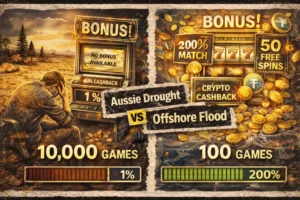
The Great Australian Bonus Drought: Why Local Offers Can’t Compete with Offshore
We are in 2026, and the gambling landscape in Australia has changed beyond recognition. If you’re an experienced player, you likely remember the times when every local betting app showered you with offers. Today, opening a licensed Australian app, you see… silence.…Jan 19, 2026 Read More -

10,000 Games vs. 100: Why Offshore Pokies Libraries are Beating Local Clubs
Remember that feeling familiar to every Australian: you walk into your local club or RSL, pass the bar, and head to the gaming area. What do you see? The same old machines you played five years ago. Maybe a couple of new…Jan 19, 2026 Read More -

BitStarz vs. the Local TAB: Why Offshore Casinos Are Beating Australian Bookies in 2026
PokieKing.com welcomes you to the world of gambling analytics in 2026. The betting culture in Australia and New Zealand is deeply ingrained in our DNA. For many, a Saturday was traditionally associated with a trip to the local pub or TAB branch to…Jan 19, 2026 Read More